Saturday, 10 January 2015

Dungeon Escape Level - Level Sound Design

The overall design of the level with regards to appearance sets it firmly in the zone of a horror/suspense/adventure genre. The visual design will be capitalised to present a sound design which is both fitting and convincing. The sound will veer more on the horror and suspense elements but with the quest involving picking up treasure, finding items and opening timed gates it will enrol an adventure element too.
     

Story?

Previously the idea of a back story was presented to give the player information with regards to their location, why they are there and what they are supposed to do. This idea has been dropped for a couple of reasons. 

Firstly the creation of a story (one which is actually good enough to draw the player in) is an extra task that has not been planned for and feel at this stage it mat consume more time than is available. Also a story may give too much away to the player, it is preferred if they don't know what to expect. This way perhaps a greater level of tension can be achieved which brings me to the second point. 

If they player has no story to work with then they will be forced to subconsciously make some decisions about what is going on in the level. The idea is that the sound design of the level will force the player to paint a mental image of the story just how they imagine it. This is aimed to draw more of their attention to the game by forcing them to think about questions such as; Why am I here? What is going on?  Allowing them to become more immersed in the game. 

Picking up on the study by Brown & Cairns they state “If gamers need to attend to sound, as well as sight more effort is needed to be placed into the game. The more attention and effort invested, the more immersed a gamer can feel.” (Brown & Cairns. 2004, p. 3). 


Creating a threat

As mentioned in the level evaluation post the threat of an enemy is essential for creating tension. Physically placing a foe of some description in the level is a great idea, however without the assets for a suitable enemy (which fits the aesthetics of the level) such as some kind of monster character, this is not an option. This would also require a lot of extra time coding on my part to get an NPC functioning desirably.

The solution is to try and create a sense of threat through the use of audio which is more suitable to this project. The initial Idea is to try and use the camera actors within UDK to create a cut scene in which the player is viewing through the eyes of the threat (The threat will be defined as the beast from here on in). There will be a trigger point when the player gets to a certain location in the level that will cut the players view and switch to the view of the beast. The camera will simulate the beast moving through the level and towards the player location. Use of music and sound effects to signify the presence of the beast will help to inform the player of the imminent threat posed. 

To bolster the idea in the mind of the player that there is a beast some other sound solutions should also be considered. Such as moveable sounds using the UDK 'Matinee' which will allow the cue to be animated and shift location during game play. This will create a spatial sense that the beast is moving around the players location. 


Player Becoming the Character

A link needs to be made between the player and character so they really get a sense of being in their shoes so to speak. To achieve this a character breathing system will be devised where the characters breathing changes depending on the actions the player takes. The plan is to record breathing sounds using a pair of in ear binaural microphones with the aim of creating an illusion of the breath coming from the player. This approach should work better than mono cues (recorded face on to a microphone) which would play back with a sonic image of the character breathing in front of your face. 


Gameplay Feedback

Game play feedback sound will be used to give the player an audio cue which signifies that they have completed a task. These will be used in a non diegetic sense These sounds will include things like key/relic pick-ups, shifting walls and the placement of relics in the alter. most of the feedback sounds should be of a rewarding nature and encourage the player to keep playing and completing objectives.

References:
Brown, E. and Cairns, P. (2004). A Grounded Investigation of Game Immersion. Extended Abstracts of the 2004 Conference on Human Factors and Computing Systems, Vienna April 24-29 2004. New York: ACM. pp. 1297-1300. [online]. Available from: http://www-users.cs.york.ac.uk/~pcairns/papers/Immersion.pdf [Accessed 1st November 2014]


Friday, 9 January 2015

Level Sound Categorisation (IZEA)

Following the investigation into the IZEA Framework I have complied a list of all sounds which will be used in game and mapped them within the IZEA.

This has helped to formulate exactly where and how the audio assets will be used and interacted with. This framework will be used a referencing guide as the implementation phase develops.

Monday, 5 January 2015

Dungeon Level editing - 01

I began to make some adjustments to the dungeon level to make it more suitable for the project. The first task was to strip all existing audio from the level to make way for the custom sound design, this included deleting all visible sound nodes from the map as well as those which were triggered from within the Kismet.

Side view of UDK map

Top down view of UDK map
To enhance the horror genre and incite the threat of death some blood detail was added throughout the dungeon using the UDK editing tools.
Blood detail next to a switch gives the impression that someone has been here before and failed to escape alive

More blood trails with hand prints tells the player someone had a bloody struggle.
As described in the level evaluation some switches and hidden pathways are very difficult to find and only due to seeing the switches in the UDK edit window was I able to find them. With this in mind some visual clues were added. These visual clues will be used for the visually orientated test level. For the aural focused test these clues will be sound based and the player must rely on their ears to find what they are looking for.

Blood arrow points to a barely visible switch


Monday, 29 December 2014

Location Recording Session 01

Today some recordings were carried out within a disused farm building containing large steel grain bins. The plan was to capture some metallic sounds to be used in the creation of assets for the dungeon level. A Zoom H2n along with a guitar pickup was used to capture the majority of the metallic recordings.

The guitar pickup was most successful when held a few millimetres away from the metal of the grain bin, whilst using a piece of  angle steel to to create impact sounds and scraping sounds. By using the guitar pick up I maximised the resonant sound emitted from the bin whilst eliminating all room space noise. Examples are below:


Some additional recordings were also captured from various mechanical devices throughout the building as well as some footstep sounds, some additional editing of these will be required however due to the nature of the location. Background noise levels were an issue along with the large reverberant space of the building but that aside I feel the sounds can be cleaned up for application to the project. 


Monday, 22 December 2014

Dungeon Escape level - Evaluation

The level is set in what appears to be an underground dungeon consisting of stone rooms and corridors. The dungeon is lit by flame torches for the most part, aside from one area which opens up into a cave which is lit through the roof (an opening to the outside world and moodlit sky).

The game objective is to try and escape the dungeon by finding 3 relics which are to be inserted into an alter which in turn opens the escape door. There are also 3 treasure chests in the level that can be opened by keys which are hidden within the level. In order to find both relics and keys the player must navigate through the dungeon by solving how to open gateways using various switches.

Some design concerns which need addressed:


  • These is no backstory or direction, the player has no idea why they are there and what they are supposed to do.
The initial idea here is to create a short backstory which test players can read before playing the level. Another possible route is to use expositional dialogue spoken in game by the character as they navigate through the level.
  • These are no enemies or any traps which end the characters life, this could lead to player boredom. 
Sound could be used to imply the threat of danger such as the sound of a beast stalking the player, however this would only work on one completion of the level. Creating an actual creature which is present and visible is an option but is also well outside of my skillset. Perhaps an invisible enemy could be created and tracked by the player through the use of sound. A timer could also be enforced to push the player to focus more on completion.


  • There is no reward by collecting treasure, when the player escapes the end screen either reads that you escaped with or without treasure.
Hearing a gratifying sound when treasure is found will be essential but also more recognition should be awarded at the end sequence.


Saturday, 20 December 2014

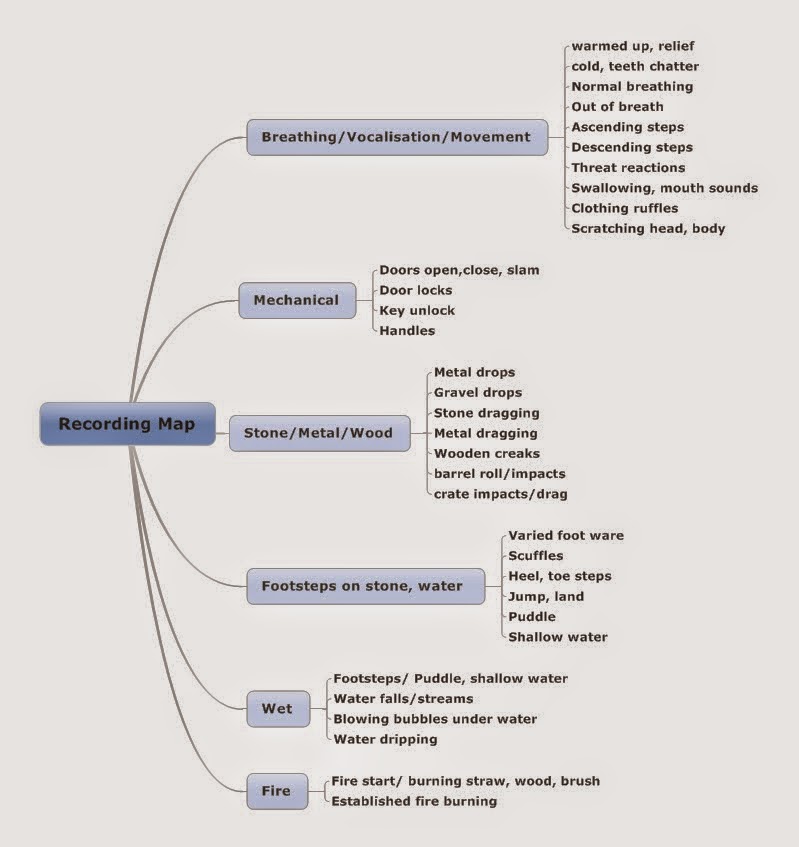
Basic Recording Map

A map was created in reference to the Basic Sound Map and details which sounds are required to be recorded. Session plans will follow on from this map and detail suitable locations, props, recording techniques and so on.


Saturday, 13 December 2014

Game Level Concept - Game review (The Last of Us)

This is a review of some key audio features included in "The Last of Us".

One of the main factors that personally drew me to 'The Last of Us' was the dynamic use of audio to focus player attention on aspects of gameplay. 


Listening focus

For much of the game the player must sneak around undetected if they wish to live. In order to be effective at moving around undetected the player can use a focus function where they are essentially listening for threats. When entered, the focus mode sends the bulk of in game audio through a low pass filter, with threat sounds such as enemy noises left largely unaffected. This works in combination with a visual effect of everything being slightly blurred and out of focus. This feature works to great effect especially as the main threat throughout the game comes from zombie like creatures that make a distinctive clicking sound. The 'clickers' have no vision and use this sound as an echo location mechanism, this also means that the player can also be detected if they make any sudden movements near a clicker. The focus feature at its core is a device which draws on more of the players attention, as well as make the player empathise with the characters situation. The fact that the player must actively listen (or pay the price) throughout much of the game is arguably a strong contributor to the games immersive nature.

The use of space is also a strong point in the game. Room spaces and tonal changes from one room to the next are highly audible. This is especially evident when in focus mode where the player can hear enemy sound from behind a wall. The spatialised presence of enemies along with realistic room acoustics solidifies the players 'presence' within the game. This is arguably one of the key immersive gameplay factor in the game as the player is essentially forced to tune into the character hearing system.

From an audio perspective a lot can be gained from the core mechanics of 'The Last Of Us ', the main point being to incorporate the players ears as much, if not more at times than the visual or mental elements of gameplay. It is the developers utilisation and effective balance of all the players senses that personally make this game so immersive.    

In this case as in most AAA rated games the storyline is also a major hook to get the players attention. Here there has been an apocalyptic event where there is an outbreak of a fungal virus which takes over the human body, leading to a zombie like state. As impressive as the opening of the game was in 'The Last Of Us' it would have stood for nothing if the gameplay experience did not match expectations.

A story element for this project would be a consideration although not fitting with the objective of identifying the connection between audio and immersion.